MemoHoney Official Website › Articles › Evidence
EvidenceThe Trials Behind This Label Were Run On Athletes
Four of the six key papers behind this ingredient list studied athletes or trained young men, usually while they exercised hard.
The buyers on this desk are between 41 and 61 and are mostly sitting down. A result belongs to the people it was measured in, and moving it to a different group is a judgement rather than a finding.
Who was actually in the room
Pick any ingredient on a memory label of this kind and follow its strongest citation back to the paper. Then, before reading the result, read the methods section and write down who was in the trial. On this particular list the answer is remarkably consistent, and it is not the person buying the bottle.
This matters more than it sounds. A result belongs to the people it was measured in. Extending it to a different group is a judgement rather than a finding, and it is a judgement a label never shows its working for.
Nothing below is medical advice, and MemoHoney is a supplement, not a treatment. A memory change that other people have noticed, or one that has grown steadily worse month on month, deserves an assessment rather than a purchase. MedlinePlus sets out what is worth reporting and to whom.
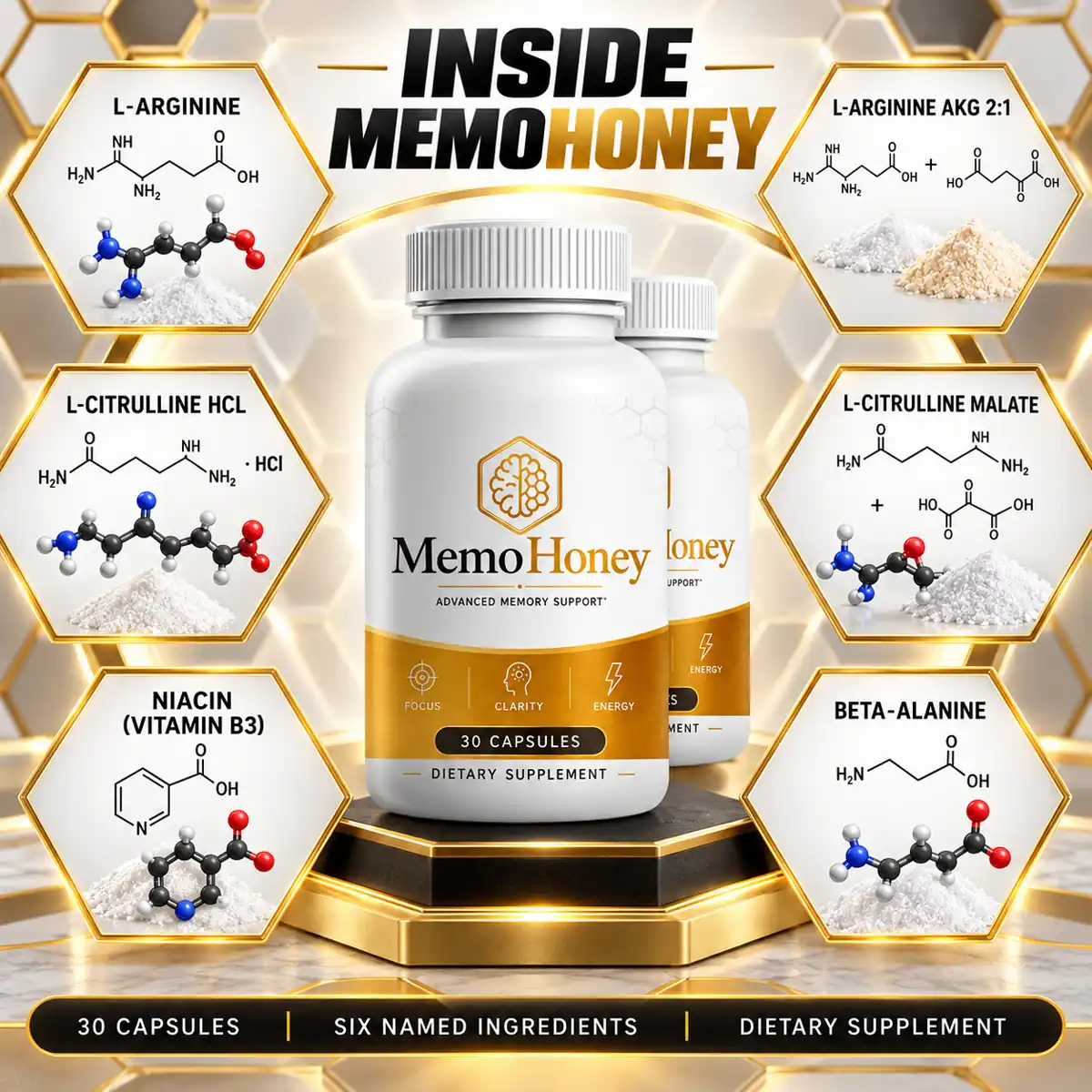
The six names and the people behind each one
| Ingredient | Who the key trial studied | What they were doing |
|---|---|---|
| L-Citrulline HCL | Taekwondo athletes | Sprint interval training, five days at 8.8 g a day |
| L-Citrulline Malate | Trained male team-sport athletes | Repeated sprint running, three days at 8 g a day |
| L-Arginine AKG 2:1 | Trained adult men | Resistance training, 12 g a day split three ways |
| L-Arginine | Healthy adults in a metabolic study | A single labelled meal, tracked isotopically |
| Beta-Alanine | Men and women aged 60 to 80 | 2.4 g a day, with brain imaging as the outcome |
| Niacin (Vitamin B3) | An older-adult dietary cohort | Eating ordinarily, observed rather than assigned |
One row in six describes people of the age this product is marketed to, and that row is an observational cohort rather than a trial.
Read down the middle column. Four of the six key papers were run on athletes or trained men. One was a metabolic study in healthy adults. The two rows that involve older people are the beta-alanine imaging trial, which is small and measured a scan rather than a memory, and the niacin cohort, which assigned nobody anything at all.
What a population mismatch actually costs
Scientists call this external validity: the degree to which a result travels outside the room it was produced in. It is not an abstract worry, and in this case there are three concrete reasons it bites.
The first is baseline. A trained twenty-two-year-old has vascular function near the top of the human range. Somebody of fifty-six has more room to move, which cuts both ways: more to gain in principle, and a different physiology to gain it in.
The second is the co-intervention. Almost every trial in the middle column involved hard exercise, and exercise is doing an enormous amount of work in those results. The supplement was measured while somebody sprinted. A capsule taken beside a desk is a different experiment.
The third is the outcome. Sprint repeatability and cerebrovascular response during interval training are not memory. They are plausible upstream of it, which is exactly the kind of chain that sounds convincing and has never been measured end to end.
- Who was in it: age, sex, training status, and whether anybody was unwell.
- What else they were doing: exercise, a diet, another supplement, or nothing.
- What was measured: the thing you care about, or something believed to lead to it.
The one row that points the other way
The beta-alanine imaging trial is the exception worth taking seriously, because it did what the others did not: it studied men and women aged 60 to 80 at 2.4 g a day, and it looked at the brain rather than at a running track.
What it found was a change in fractional anisotropy scores in the hippocampus and the amygdala. That is a structural imaging measure, and the distance between a scan change and remembering where you left your keys is still considerable. But the population is right, which is more than can be said for four of the other five rows.
The niacin row is the other partial exception, and it fails differently. The Chicago Health and Aging Project followed older adults eating their own diets, which is the right population and the wrong design: people who eat more niacin differ from people who eat less in a dozen ways an observational study cannot separate.
Read the MemoHoney label while this is in front of you
Six named ingredients, the amount each published trial used printed beside them, and 60 days from the date of purchase to decide.
Two bottles $158 · six bottles $294 · 60-day money-back guarantee
Order MemoHoney From This CounterLot MEM-26/ME-8302 · one a morning, 30 to a bottle · ships from the United States
What a well-matched trial would look like
It is worth describing, because it makes the gap concrete. A trial that would actually support a label like this one would recruit adults in their fifties and sixties who are not athletes, give them this exact combination at the amounts the capsule contains, run for the eight weeks buyers report waiting, and measure memory with a validated battery against a placebo.
- The right people: the age and the activity level of the person buying it.
- The right product: the combination, not six separate compounds.
- The right amount: whatever is actually in the capsule, which on this label is not published.
- The right duration: at least as long as the wait the seller itself reports.
- The right outcome: memory, measured, against a placebo.
No such trial exists for this product. That is an ordinary state of affairs in this category rather than a scandal, and the honest thing is to say so and let a reader price it. It also explains why the dosage page on this site prints trial amounts rather than label amounts: the trial amount is the only number anybody has.
How other approaches score on the same test
| Approach | Population studied | Outcome measured |
|---|---|---|
| This ingredient family | Mostly athletes and trained men | Blood pressure, sprint capacity, blood flow |
| Ginkgo biloba | Over 3,000 older adults | Incident dementia, over years |
| A daily multivitamin | Older adults | Memory, against placebo |
| Hearing treatment | Older adults with hearing loss | Cognitive decline over three years |
| Blood pressure control | Adults at cardiovascular risk | Probable dementia and mild cognitive impairment |
The bottom three rows study the people who buy memory products and measure the thing those people care about. The top row does neither.
Ginkgo is on that table for an uncomfortable reason: it was studied properly, in the right people, with the right outcome, and the answer was no. That is more useful information than any of the positive results above it, and it is the standard the rest of the shelf has not been held to.
Why the literature ends up looking like this
It is worth understanding, because it stops the pattern looking like a conspiracy. Nobody set out to study the wrong people. The trials behind this family were run where the funding, the research questions and the volunteers happened to be, and for these compounds all three were in sports science.
Athletes and trained students are the convenience sample of an exercise physiology department. They are available, they are healthy enough to be given gram-scale amino acids without much worry, and they can be measured doing something strenuous in an afternoon. An eight-week cognitive trial in sixty-year-olds costs an order of magnitude more and answers a question nobody in that department was asking.
The result is a literature that is genuinely good at what it set out to do and was never designed to answer the question printed on this bottle. The marketing travelled; the evidence did not.
- Short trials, because performance outcomes can be measured in days.
- Young participants, because they are who is in the building.
- Exercise outcomes, because that is what the department studies.
- Single compounds, because a combination result would apply only to that combination.
Who the seller says this is for
Set the trial populations beside the seller's own description of its customer and the distance is easy to see. The listing panel supplied with this product describes adults who keep a full calendar, read before bed and want one habit to anchor the start of the day. The roster on this desk runs from 41 to 61.
Neither of those descriptions contains the word athlete, and neither contains the word sprint. That is not dishonesty on the seller's part. It is the gap between who a product is sold to and who its ingredients were tested in, and it is a gap a buyer can only see if somebody prints both halves of it.
What a reader should actually do with this
- Treat a trial in athletes as evidence that a mechanism exists, not as evidence that it helps you.
- Ask what else the participants were doing. If the answer is sprint intervals, the sprint intervals are part of the result.
- Prefer a trial that measured the thing you care about over one that measured something upstream of it.
- Use the 60-day window as the only trial you can actually run on the relevant population, which is you. The timeline page sets out the dates.
A real mechanism, demonstrated in people who are not the buyer, at amounts the buyer cannot verify, for outcomes that are not memory. Every clause of that sentence is checkable, and none of them means the product is a fraud. They mean it is unproven, which is a different and much more common thing.
- Li A, Li H, Chen J: “The effects of L-citrulline supplementation on cerebrovascular function during sprint interval training in taekwondo athletes” · J Exerc Sci Fit, 2025 · 23(3):222-228 · PMID 40474881.
- Faria VS, Egan B: “Effects of 3 days of citrulline malate supplementation on short-duration repeated sprint running performance in male team sport athletes” · Eur J Sport Sci, 2024 · 24(6):758-765 · PMID 38874989.
- Campbell B, Roberts M, Kerksick C, et al: “Pharmacokinetics, safety, and effects on exercise performance of L-arginine alpha-ketoglutarate in trained adult men” · Nutrition, 2006 · 22(9):872-81 · PMID 16928472.
- Mariotti F, Petzke KJ, Bonnet D, et al: “Kinetics of the utilization of dietary arginine for nitric oxide and urea synthesis: insight into the arginine-nitric oxide metabolic system in humans” · Am J Clin Nutr, 2013 · 97(5):972-9 · PMID 23535108.
- Ostfeld I, Zamir A, Ben-Zeev T, et al: “β-Alanine supplementation improves fractional anisotropy scores in the hippocampus and amygdala in 60-80-year-old men and women” · Exp Gerontol, 2024 · 194:112513 · PMID 38971131.
- Morris MC, Evans DA, Bienias JL, et al: “Dietary niacin and the risk of incident Alzheimer's disease and of cognitive decline” · J Neurol Neurosurg Psychiatry, 2004 · 75(8):1093-9 · PMID 15258207.
- DeKosky ST, Williamson JD, Fitzpatrick AL, et al: “Ginkgo biloba for prevention of dementia: a randomized controlled trial” · JAMA, 2008 · 300(19):2253-62 · PMID 19017911.
- Yeung LK, Alschuler DM, Wall M, et al: “Multivitamin Supplementation Improves Memory in Older Adults: A Randomized Clinical Trial” · Am J Clin Nutr, 2023 · 118(1):273-282 · PMID 37244291.
- Lin FR, Pike JR, Albert MS, et al: “Hearing intervention versus health education control to reduce cognitive decline in older adults with hearing loss in the USA (ACHIEVE): a multicentre, randomised controlled trial” · Lancet, 2023 · 402(10404):786-797 · PMID 37478886.
- SPRINT MIND Investigators for the SPRINT Research Group; Williamson JD, Pajewski NM, et al: “Effect of Intensive vs Standard Blood Pressure Control on Probable Dementia: A Randomized Clinical Trial” · JAMA, 2019 · 321(6):553-561 · PMID 30688979.
- Memory, from MedlinePlus, US National Library of Medicine (medlineplus.gov).