MemoHoney Official Website › MemoHoney Ingredients
MemoHoney IngredientsMemoHoney Ingredients: Six Names, Four Forms, Two Working Molecules
Six ingredients are named on the artwork and every one of them is named in full.
Nothing is pooled behind a proprietary blend. What the artwork does not carry is a Supplement Facts panel, so no amount is printed for any of the six. Each name below is therefore set beside the amount a published trial used, with the people it was given to and the thing it measured attached.
Four of the six names resolve to two molecules in different chemical company, and five of the six were studied in a field that has nothing to do with memory. Both of those are worth knowing before anything else on this page.
Where the MemoHoney ingredient list actually comes from
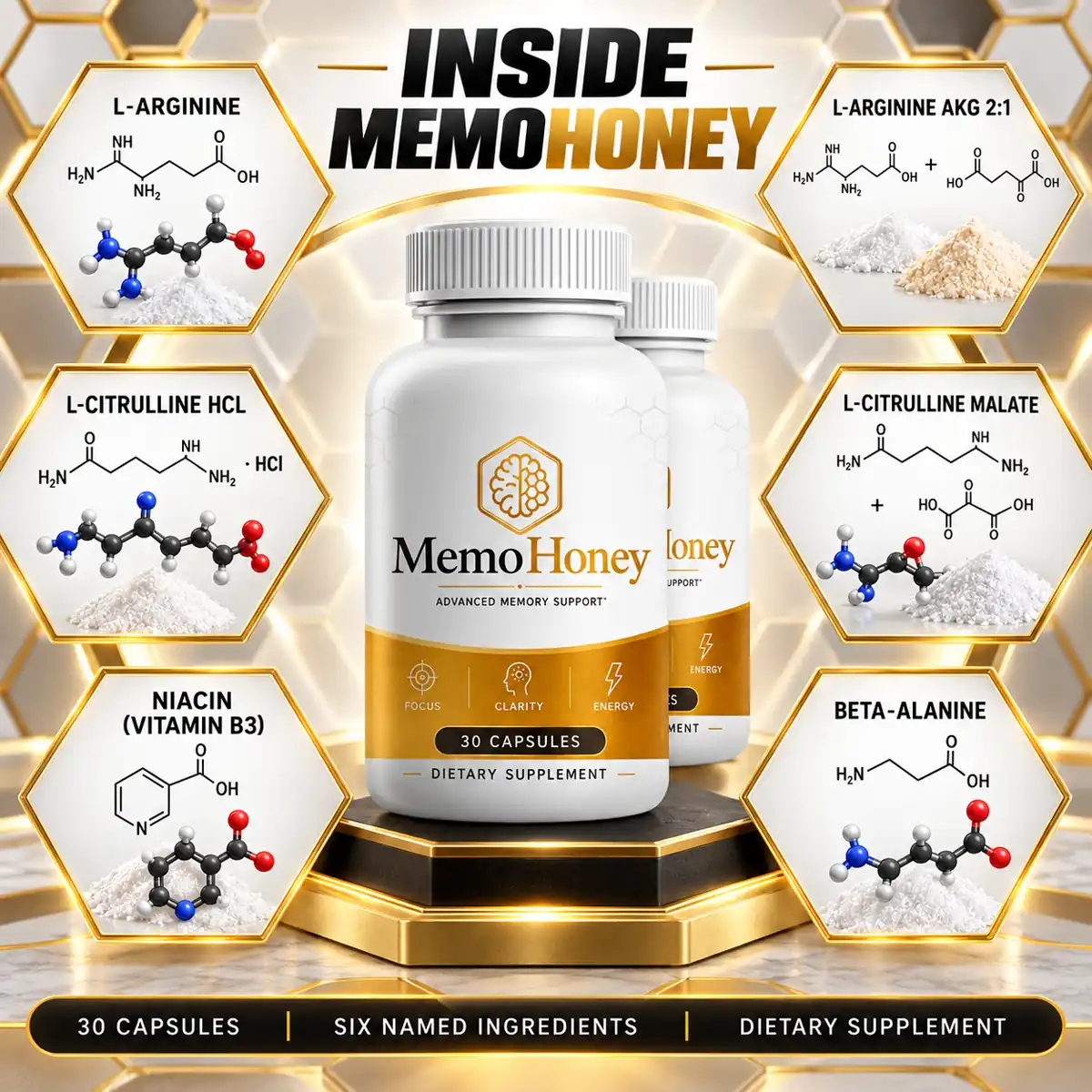
Not from the bottle. The bottle front carries the brand, the phrase Advanced Memory Support, three words on a gold band and the count. The six names live on a separate tile graphic headed INSIDE MEMOHONEY, which sets each one in a honeycomb hexagon with a molecular diagram beside it.
That graphic agrees with the typed list supplied with this product: the same six names in the same order. On several products in this category the advertising names fewer ingredients than the container does, and the gap is usually the most interesting thing about the label. Here there is no gap. The two sources agree, and what they agree on is six names and not one figure.
- The count: 30 capsules
- The category: dietary supplement
- The number of named ingredients: six
- The three claim words on the gold band: focus, clarity, energy
- No serving size, no milligram figure, no percent Daily Value, and no Other Ingredients line
What each MemoHoney ingredient is, and where its research sits
Six cards, one per name. Every amount in them belongs to a trial rather than to this bottle.
L-Arginine
Amino acidBlood pressure, exercise capacity and vascular functionNitric oxide is made from it directly, and most of an oral dose never gets the chance.
An enzyme called nitric oxide synthase converts arginine straight into nitric oxide, the short-lived gas that tells the muscle wrapped around a blood vessel to let go. That part is not in dispute. What is in dispute is how much of a swallowed dose ever arrives: the gut wall and the liver between them take most of it before the blood does.
What a trial used: A labelled-meal study followed a single dietary dose to see how much became nitric oxide; supplement trials work in grams. a stable-isotope study of dietary arginine.
L-Arginine AKG 2:1 Extract
Amino acid saltResistance training and blood flow in trained young menTwo parts arginine to one part alpha-ketoglutarate, and a pre-workout ingredient by origin.
Arginine bound to alpha-ketoglutarate in a two-to-one ratio. The pairing is sold on the idea that the salt survives the trip better than plain arginine does, and the seller's page adds that it spreads the effect across the day.
What a trial used: 12 g a day, taken as 4 g three times, in the pharmacokinetic trial. the arginine AKG pharmacokinetic trial.
L-Citrulline HCL
Amino acid saltCerebral blood flow during hard interval exerciseThe precursor that gets past the gut, then becomes arginine at the kidney.
Citrulline slips past the enzymes that strip out most oral arginine, and the kidney converts it onward. Gram for gram it raises blood arginine more dependably than arginine itself does, which is the whole reason this compound exists in supplement form.
What a trial used: 8.8 g a day for five days in the one trial that measured blood flow in the brain. the citrulline cerebrovascular trial.
L-Citrulline Malate
Amino acid saltRepeated sprints, resistance training, and one trial in older womenThe same citrulline carried on malic acid. Most of the sports literature used this form.
Citrulline bound to malate rather than hydrochloride. Malate is an intermediate in the cycle cells use to make energy, which is where the seller's line about clearing metabolic waste comes from. It is also the form that the trials in this field mostly ran on.
What a trial used: 8 g a day for three days; 8 g and 12 g compared head to head in a single dose. a three-day citrulline malate trial.
Niacin (Vitamin B3)
VitaminA long-running dietary cohort rather than a randomised trialThe only ingredient here whose useful amount is measured in milligrams.
The body turns niacin into NAD and NADP, the two electron shuttles that run energy metabolism in every cell, neurons included. A severe shortage produces pellagra, whose third classical symptom is dementia, which is the honest reason a B vitamin appears on a memory label at all.
What a trial used: Dietary intakes in the low tens of milligrams a day; the US tolerable upper intake level for supplemental niacin is 35 mg. the Chicago Health and Aging Project analysis.
Beta-Alanine
Amino acidExercise capacity, plus one small brain-imaging trial in older adultsHalf of carnosine, and the half the body runs short of.
Carnosine is built from two amino acids and beta-alanine is the one in short supply, so supplying it is what raises carnosine. Carnosine buffers acid inside muscle and is also present in brain tissue, which is the thread the seller's antioxidant line is pulling on.
What a trial used: 2.4 g a day in the imaging trial; 3.2 to 6.4 g a day across the sports meta-analysis. the beta-alanine brain-imaging trial.
The MemoHoney label set beside the published trials
The quarantine section. The comparison is made once, here, and pointed at from everywhere else on the site.
Read down the third column and the pattern is not subtle. The amounts are grams; they belong to trials that gave one compound at a time; and the people in most of them were exercising hard while it was measured. A once-daily capsule shared between six ingredients cannot reproduce that, and this table exists so that nobody has to guess about it in either direction.
Niacin is the exception and it deserves saying plainly. Its useful range is milligrams, and the US tolerable upper intake level is 35 mg a day from supplements. That fits inside a capsule with room to spare, which makes it the one ingredient here whose effective amount and whose format agree with each other.
How many milligrams of each. The route to that answer is the order desk on +1 (302) 200-3480, quoting lot MEM-26/ME-8302 and certificate reference MEM-8302-26-ME. If a panel is ever published this page changes in the same week and the review date at the foot of it moves.
Why two molecules appear on the MemoHoney label in four forms
Arginine and citrulline are consecutive steps of one cycle and both appear here twice. It looks like list-padding until you know what each form is for.
Arginine is the direct substrate: the enzyme nitric oxide synthase acts on arginine and on nothing else. The difficulty is arrival. A large share of any oral dose is broken down by arginase in the gut wall and the liver before it reaches the general circulation, which is what the stable-isotope work set out to quantify.
Citrulline is the way around that. It passes the gut and liver largely untouched and the kidney converts it onward, so gram for gram it raises plasma arginine more dependably than arginine does. A human availability study put figures on it and a quantitative characterisation traced the conversion in detail. Giving both together raises plasma arginine faster than either alone, which is a defensible reason for a label to carry the pair.
L-Arginine and L-Arginine AKG 2:1
The free amino acid, and a salt of it bound to alpha-ketoglutarate two parts to one. The salt comes off the pre-workout shelf and is sold on better survival to the blood. Its pharmacokinetic trial gave 12 g a day; a single 3 g dose before one session and seven days at 12 g a day each failed to move the performance measures they were watching.
L-Citrulline HCL and L-Citrulline Malate
The same amino acid on two different partners. Hydrochloride is the plain salt; malate adds an intermediate of the cell’s own energy cycle, and it is the form most of the sports literature actually used — three days at 8 g a day for repeated sprints, and 8 g against 12 g head to head in a single dose.
Niacin (Vitamin B3)
The one non-amino-acid on the list. It becomes NAD and NADP, which every cell needs for energy metabolism. A long-running dietary cohort found higher niacin intake associated with slower cognitive decline, and an association in a cohort is not a trial result.
Beta-Alanine
The rate-limiting half of carnosine, which buffers acid in muscle and is present in brain tissue. The sports evidence is a meta-analysis with a pooled effect size of 0.18; the cognitive evidence is one imaging trial in adults aged 60 to 80 at 2.4 g a day.
What is not on the MemoHoney label, and what that means
Three absences are worth naming once, because a reader comparing labels will look for them:
- An Other Ingredients line. That is where fillers, flow agents and the capsule shell are normally listed. The seller describes the shell separately as a hypromellose vegetable capsule.
- An allergen statement. The dairy-free and gluten-free emblems cover two of the common ones between them, and an emblem is a claim rather than a tested figure.
- A percent Daily Value column, which niacin would have if an amount were printed for it.
None of those three makes the product unsafe and none of them is unusual in this category. They are listed because a reader deciding between two bottles deserves to know which questions each one answers. The testing and quality page covers what the emblems do and do not certify.
Sources behind the MemoHoney ingredient page
Thirteen records, each resolved through the NCBI summary service and written out from the fields it returned.
- Mariotti F, Petzke KJ, Bonnet D, et al. Kinetics of the utilization of dietary arginine for nitric oxide and urea synthesis: insight into the arginine-nitric oxide metabolic system in humans. Am J Clin Nutr. 2013;97(5):972-9. PMID 23535108. https://pubmed.ncbi.nlm.nih.gov/23535108/
- Morita M, Hayashi T, Ochiai M, et al. Oral supplementation with a combination of L-citrulline and L-arginine rapidly increases plasma L-arginine concentration and enhances NO bioavailability. Biochem Biophys Res Commun. 2014;454(1):53-7. PMID 25445598. https://pubmed.ncbi.nlm.nih.gov/25445598/
- Campbell B, Roberts M, Kerksick C, et al. Pharmacokinetics, safety, and effects on exercise performance of L-arginine alpha-ketoglutarate in trained adult men. Nutrition. 2006;22(9):872-81. PMID 16928472. https://pubmed.ncbi.nlm.nih.gov/16928472/
- Wax B, Kavazis AN, Webb HE, et al. Acute L-arginine alpha ketoglutarate supplementation fails to improve muscular performance in resistance trained and untrained men. J Int Soc Sports Nutr. 2012;9(1):17. PMID 22510253. https://pubmed.ncbi.nlm.nih.gov/22510253/
- Willoughby DS, Boucher T, Reid J, et al. Effects of 7 days of arginine-alpha-ketoglutarate supplementation on blood flow, plasma L-arginine, nitric oxide metabolites, and asymmetric dimethyl arginine after resistance exercise. Int J Sport Nutr Exerc Metab. 2011;21(4):291-9. PMID 21813912. https://pubmed.ncbi.nlm.nih.gov/21813912/
- Rougé C, Des Robert C, Robins A, et al. Manipulation of citrulline availability in humans. Am J Physiol Gastrointest Liver Physiol. 2007;293(5):G1061-7. PMID 17901164. https://pubmed.ncbi.nlm.nih.gov/17901164/
- Song S, Thapa SK, Upadhyay M, et al. Quantitative characterization of L-citrulline as a precursor of L-arginine in rats: pharmacokinetic basis for nitric oxide-mediated effects. Front Pharmacol. 2026;17:1889835. PMID 42755674. https://pubmed.ncbi.nlm.nih.gov/42755674/
- Faria VS, Egan B. Effects of 3 days of citrulline malate supplementation on short-duration repeated sprint running performance in male team sport athletes. Eur J Sport Sci. 2024;24(6):758-765. PMID 38874989. https://pubmed.ncbi.nlm.nih.gov/38874989/
- Gough LA, Tan R, Bailey SJ, et al. The Comparative Effect of Acute Moderate- and High-Dose Citrulline Malate on Resistance Exercise Performance in Trained Individuals: A Double-Blind Randomised Controlled Pilot Trial. J Funct Morphol Kinesiol. 2026;11(1). PMID 41900522. https://pubmed.ncbi.nlm.nih.gov/41900522/
- Morris MC, Evans DA, Bienias JL, et al. Dietary niacin and the risk of incident Alzheimer's disease and of cognitive decline. J Neurol Neurosurg Psychiatry. 2004;75(8):1093-9. PMID 15258207. https://pubmed.ncbi.nlm.nih.gov/15258207/
- Minto C, Vecchio MG, Lamprecht M, et al. Definition of a tolerable upper intake level of niacin: a systematic review and meta-analysis of the dose-dependent effects of nicotinamide and nicotinic acid supplementation. Nutr Rev. 2017;75(6):471-490. PMID 28541582. https://pubmed.ncbi.nlm.nih.gov/28541582/
- Ostfeld I, Zamir A, Ben-Zeev T, et al. β-Alanine supplementation improves fractional anisotropy scores in the hippocampus and amygdala in 60-80-year-old men and women. Exp Gerontol. 2024;194:112513. PMID 38971131. https://pubmed.ncbi.nlm.nih.gov/38971131/
- Saunders B, Elliott-Sale K, Artioli GG, et al. β-alanine supplementation to improve exercise capacity and performance: a systematic review and meta-analysis. Br J Sports Med. 2017;51(8):658-669. PMID 27797728. https://pubmed.ncbi.nlm.nih.gov/27797728/
Order MemoHoney with the ingredient list in front of you
Six names, four forms, two working molecules and one vitamin. The amounts stay with the manufacturer, and the 60-day window is what lets a buyer test the proposition anyway.
Two bottles $158 · six bottles $294 · 60-day money-back guarantee
Order MemoHoney From This CounterLot MEM-26/ME-8302 · one a morning, 30 to a bottle · ships from the United States