MemoHoney Official Website › How It Works
How It WorksHow MemoHoney Works: One Pathway With Evidence, Two Without Much
The seller’s account has three parts: blood flow, protection and energy.
The first is a real and well-described pathway. The second rests on one small imaging trial. The third is ordinary vitamin biochemistry that only matters if you are short of the vitamin. Set out in that order, the story becomes much easier to weigh.
This page takes the mechanism the seller publishes and says, part by part, what sits behind it.
The three-part account MemoHoney is sold on
Blood flow
nitric-oxide precursors, named on the seller's page as L-arginine and L-citrulline, are said to widen cerebral blood vessels.
Protection
beta-alanine is said to raise carnosine and shield neurons from oxidative wear.
Energy
niacin is said to supply NAD+ for the energy machinery inside a neuron.
Quoted rather than paraphrased, because it is the thing a buyer is being asked to believe and it is easier to weigh in its own words. What follows takes each part in turn.
Part one: the MemoHoney blood-flow pathway, which is the well-described half
Nitric oxide is a gas with a half-life measured in seconds. It is made from arginine by an enzyme called nitric oxide synthase, it diffuses into the smooth muscle wrapped around a blood vessel, and that muscle relaxes. A relaxed vessel is a wider vessel. None of that is contested.
What is contested is how much arginine you can get there by swallowing it. Arginase in the gut wall and the liver dismantles a large share of an oral dose before it reaches the circulation, which a stable-isotope study followed through a single labelled meal. That single fact is why the citrulline literature exists: citrulline gets past those enzymes and is converted to arginine at the kidney instead.
On outcomes, the honest summary is modest and real. A 2025 meta-analysis found citrulline lowers systolic blood pressure by a small margin in middle-aged and older adults; a review of oral arginine and citrulline reaches a similar place. For the brain specifically there is one trial measuring cerebrovascular function, in taekwondo athletes during sprint interval training, at 8.8 g a day for five days.
It licenses the sentence: citrulline at gram scale has been shown to change a cerebrovascular measure in athletes during hard exercise. It does not license any sentence about remembering things, about older adults at rest, or about a capsule whose citrulline content is not printed.
Part two: the MemoHoney protection claim, which rests on one trial
Carnosine is two amino acids joined together, and beta-alanine is the half the body runs short of, so supplying beta-alanine is what raises carnosine. Carnosine buffers acid inside muscle, which is why the sports world uses it, and it is also present in brain tissue, which is the thread the protection claim pulls on.
The cognitive evidence is thin but it is not nothing. An imaging trial in men and women aged 60 to 80 gave 2.4 g a day and reported changes in fractional anisotropy scores in the hippocampus and amygdala. Fractional anisotropy is a scan measure of white-matter structure, not a memory test, and one trial is one trial. Separately, the NEAT trial gave carnosine itself, 2 g a day, and found cognitive improvement in its younger participants.
The sports evidence is much larger and points at a different outcome: a systematic review and meta-analysis across exercise-capacity trials found a pooled effect size of 0.18 at 3.2 to 6.4 g a day, which is a real but small effect on how long somebody can keep going.
Part three: the MemoHoney energy claim, which is ordinary and conditional
Niacin becomes NAD and NADP, the two carriers that shuttle electrons through energy metabolism. Every cell uses them and a neuron is no exception. A severe deficiency produces pellagra, whose classical third symptom is dementia, and that is the honest reason a B vitamin belongs on a label like this one.
The conditional part is the important part. Somebody who is not short of niacin gains nothing by adding more of it, and the supplemental form has a published ceiling: 35 mg a day, set because higher amounts flush. At much higher doses niacin becomes a drug rather than a nutrient, which is what the HPS2-THRIVE trial tested and found no cardiovascular benefit from, alongside real harms.
For cognition specifically, the evidence is observational. The Chicago Health and Aging Project associated higher dietary niacin with slower decline, and a 2025 analysis of B vitamin intake points the same way. Associations in a cohort describe people who eat differently in many ways at once.
What the MemoHoney mechanism cannot tell you
Every sentence above has an amount in it, and this product prints none. That is the whole of the difficulty, and it is set out properly on the dosage analysis rather than re-argued here.
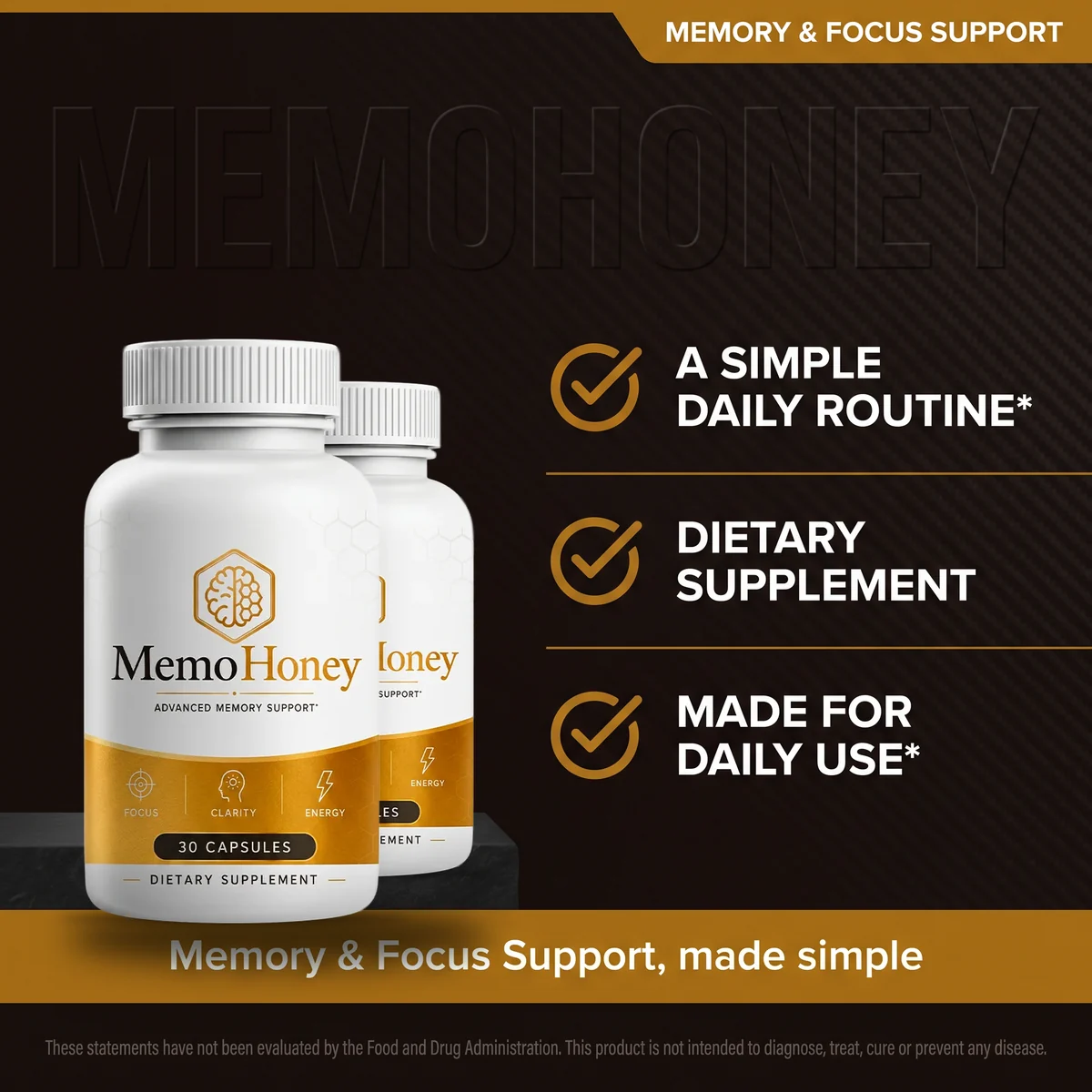
What can be said without an amount is this. The pathway is real. The forms chosen are the ones with the better absorption case behind them. The vitamin is one with a known role and a known ceiling. And the whole arrangement is delivered as one capsule a morning, which is a routine most people can actually keep.
That is a fair description of a reasonable formulation with an unpublished dose. It is not a description of a proven effect, and anyone selling it as one is going further than the evidence goes.
Sources behind the MemoHoney mechanism page
Eleven records, in the order this page reaches for them.
- Mariotti F, Petzke KJ, Bonnet D, et al. Kinetics of the utilization of dietary arginine for nitric oxide and urea synthesis: insight into the arginine-nitric oxide metabolic system in humans. Am J Clin Nutr. 2013;97(5):972-9. PMID 23535108. https://pubmed.ncbi.nlm.nih.gov/23535108/
- Khalaf D, Krüger M, Wehland M, et al. The Effects of Oral l-Arginine and l-Citrulline Supplementation on Blood Pressure. Nutrients. 2019;11(7):1679. PMID 31336573. https://pubmed.ncbi.nlm.nih.gov/31336573/
- Luo P, Chen J, Liu K, et al. Does l-citrulline supplementation and watermelon intake reduce blood pressure in middle-aged and older adults? A systematic review and meta-analysis of randomized controlled trials. Clin Nutr ESPEN. 2025;69:653-664. PMID 40789388. https://pubmed.ncbi.nlm.nih.gov/40789388/
- Li A, Li H, Chen J. The effects of L-citrulline supplementation on cerebrovascular function during sprint interval training in taekwondo athletes. J Exerc Sci Fit. 2025;23(3):222-228. PMID 40474881. https://pubmed.ncbi.nlm.nih.gov/40474881/
- Ostfeld I, Zamir A, Ben-Zeev T, et al. β-Alanine supplementation improves fractional anisotropy scores in the hippocampus and amygdala in 60-80-year-old men and women. Exp Gerontol. 2024;194:112513. PMID 38971131. https://pubmed.ncbi.nlm.nih.gov/38971131/
- Saunders B, Elliott-Sale K, Artioli GG, et al. β-alanine supplementation to improve exercise capacity and performance: a systematic review and meta-analysis. Br J Sports Med. 2017;51(8):658-669. PMID 27797728. https://pubmed.ncbi.nlm.nih.gov/27797728/
- O'Toole TE, Amraotkar AR, Gao H, et al. Carnosine supplementation improves cognitive outcomes in younger participants of the NEAT trial. Neurotherapeutics. 2025;22(2):e00541. PMID 39919936. https://pubmed.ncbi.nlm.nih.gov/39919936/
- Morris MC, Evans DA, Bienias JL, et al. Dietary niacin and the risk of incident Alzheimer's disease and of cognitive decline. J Neurol Neurosurg Psychiatry. 2004;75(8):1093-9. PMID 15258207. https://pubmed.ncbi.nlm.nih.gov/15258207/
- Minto C, Vecchio MG, Lamprecht M, et al. Definition of a tolerable upper intake level of niacin: a systematic review and meta-analysis of the dose-dependent effects of nicotinamide and nicotinic acid supplementation. Nutr Rev. 2017;75(6):471-490. PMID 28541582. https://pubmed.ncbi.nlm.nih.gov/28541582/
- HPS2-THRIVE Collaborative Group. Effects of extended-release niacin with laropiprant in high-risk patients. N Engl J Med. 2014;371(3):203-12. PMID 25014686. https://pubmed.ncbi.nlm.nih.gov/25014686/
- Chen Q, Huang J, Shi X, et al. Associations between dietary B vitamin intakes and cognitive function among elderly individuals: An observational study. Nutrition. 2025;134:112716. PMID 40056822. https://pubmed.ncbi.nlm.nih.gov/40056822/
Order MemoHoney knowing which part carries the evidence
A real pathway, a thin protection claim and a conditional vitamin story. The 60-day window from the date of purchase is what makes testing the proposition affordable.
Two bottles $158 · six bottles $294 · 60-day money-back guarantee
Order MemoHoney From This CounterLot MEM-26/ME-8302 · one a morning, 30 to a bottle · ships from the United States